


How Can I Minimize State Taxes on My Retirement Distributions?
The state that taxes your retirement distributions is almost always the state where you live when you take the money, not the state where you earned it. That puts three levers at the center of any plan: where you are a tax resident, how your income is split across account types, and when you draw from each account.
Key takeaways
- Under federal law, a state generally cannot tax the retirement distributions of someone who no longer lives there, so your state of residence when you withdraw usually decides the bill (4 U.S.C. § 114).
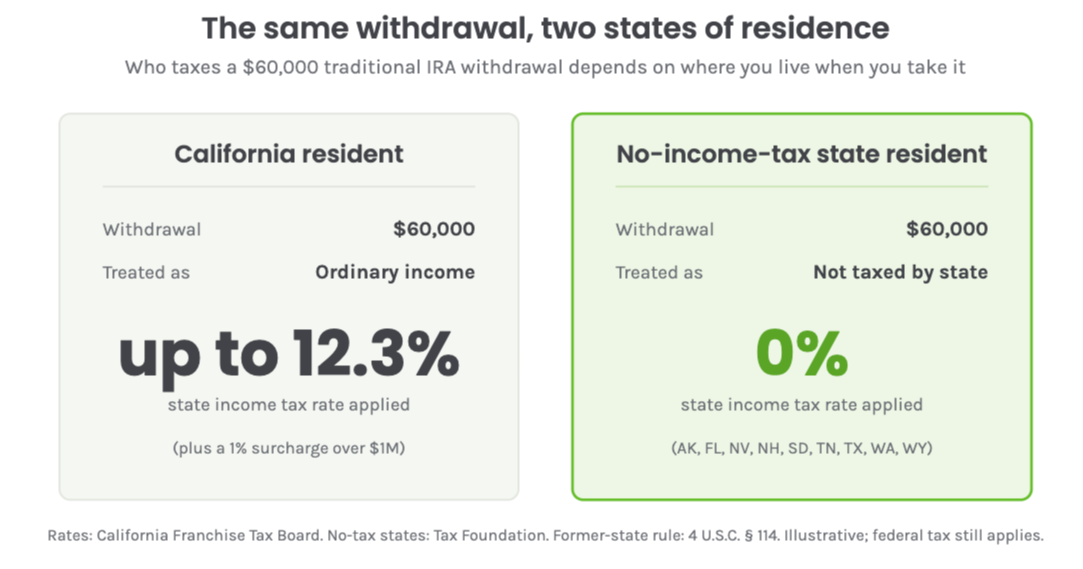
- California does not tax Social Security but taxes pensions, 401(k), 403(b), and traditional IRA withdrawals as ordinary income, at rates from 1% to 12.3%, plus a 1% surcharge over $1 million (California Franchise Tax Board).
- Nine states levy no individual income tax at all, so distributions taken as a resident there face no state income tax (Tax Foundation).
- Qualified Roth distributions come out free of federal and state income tax, because the contributions were already taxed (IRS).
- Residency, account mix, and withdrawal timing are the levers a plan can move; the rules reward coordination, not a single trick.
Which State Taxes Your Retirement Distributions?
The state where you are a resident when you take a distribution is the state that taxes it. Federal law, in effect since 1996, bars any state from taxing the retirement income of a person who is not a resident or domiciliary of that state (4 U.S.C. § 114). In practice, that means a pension or 401(k) you built over a career in one state is not taxed by that state once you have genuinely moved your residency elsewhere; the new state's rules apply instead.
The protection covers most common retirement income, including qualified employer plans, simplified employee pensions, traditional and Roth IRAs, 403(a) and 403(b) plans, governmental 457 plans, and certain streams of substantially equal periodic payments (4 U.S.C. § 114). The important caveat is that the residency has to be real and documented, not just a mailing address.
How Does California Tax Retirement Income?
California exempts Social Security but taxes most other retirement income as ordinary income. The California Franchise Tax Board does not include Social Security or Railroad Retirement benefits in state taxable income at any income level. Pensions, 401(k) and 403(b) withdrawals, and traditional IRA distributions are taxed as ordinary income under the state's graduated brackets, which run from 1% to 12.3% for 2025, with an additional 1% surcharge on taxable income above $1 million (California Franchise Tax Board).
California offers no broad age-based retirement exclusion. For tax years 2025 through 2029, qualifying taxpayers may exclude up to $20,000 of military retirement pay, subject to income limits (California Franchise Tax Board). Because capital gains also receive no preferential state rate in California, the year in which distributions and gains land can move the state bill more than people expect, which is where coordinated retirement income and cash-flow planning earns its keep.
Can Moving to Another State Lower the Tax?
Yes. Becoming a resident of a state with no income tax before you take distributions can remove the state tax on them, but only if the move is a genuine change of domicile. Nine states levy no individual income tax: Alaska, Florida, Nevada, New Hampshire, South Dakota, Tennessee, Texas, Washington, and Wyoming (Tax Foundation). A resident of one of those states who takes an IRA or pension distribution owes no state income tax on it, and the former state cannot reach back to tax it either (4 U.S.C. § 114).
Washington is the one asterisk: it has no tax on wages or ordinary distributions but does tax large long-term capital gains for high earners (Washington State Department of Revenue). A move also has to be real. California looks at where your home, your time, your licenses, your voter registration, and your financial ties are based, and it is known for examining change-of-residence claims closely. Keeping a California home, splitting the year, or returning for long stretches can all pull distributions back into the state's reach, so a planned relocation is worth coordinating well before the first big withdrawal year.
How Does Your Mix of Accounts Change the Bill?
The more of your income that comes from already-taxed sources, the smaller your state-taxable total. Qualified Roth IRA and Roth 401(k) distributions come out free of federal and state income tax, because the contributions were made with after-tax dollars (IRS). Social Security sits outside California's tax base entirely (California Franchise Tax Board). Traditional 401(k), 403(b), and IRA dollars, by contrast, are fully taxable as ordinary income when withdrawn.
A household drawing from a blend of Roth, taxable brokerage, and traditional accounts has far more control over its yearly taxable income than one pulling everything from a traditional IRA, which is a core reason how your retirement accounts are structured matters as much as how much is in them. For those who are charitably inclined and old enough to use them, qualified charitable distributions from an IRA can also satisfy required minimum distributions without adding to taxable income (IRS).
What Timing Moves Reduce State Tax?
Spreading income across years, and choosing which years to realize it, is often the most reliable state-tax lever for people who are staying put. Converting traditional dollars to Roth in a lower-income year, or in a year spent as a resident of a lower-tax or no-tax state, pays tax now to remove future distributions from the state base. Sizing withdrawals so a large one-time distribution does not stack on top of other income keeps more of it out of the top brackets.
Coordinating when Social Security, pension income, and account withdrawals begin so they do not all peak in the same years can flatten the overall tax curve. These moves interact with federal tax, required minimum distribution rules, and your day-to-day cash-flow needs, so they tend to work best mapped as part of a broader set of tax-efficient strategies rather than decided one account at a time.
Have a Question This Article Didn't Cover?
Minimizing state taxes on retirement distributions depends on your residency, your account mix, and your timeline, and the right move for one household can be the wrong one for another. The team at Zeller Kern Wealth Advisors can walk through how these rules apply to your situation and coordinate them with the rest of your plan and with your tax professional.
Schedule an Appointment or Call 916-436-8272 *Zeller Kern Wealth Advisors does not provide legal or tax advice. You should consult a legal or tax professional regarding your individual situation.